
By Lauren Duca
Middlebrow is a recap of the week in entertainment, celebrity and television news that provides a comprehensive look at the state of pop culture. From the rock bottom to highfalutin, Middlebrow is your accessible guidebook to the world of entertainment. Sign up to receive it in your inbox here.
Well, it happened: Vogue discovered big booties. In a post earlier this week, they declared that we are "officially in the era of the big booty" ... With "J.Lo to thank (or blame)." Absurd, yes, but when you get done face palming yourself, there's something really icky there. The post skips around the obvious racial overlay with the dexterity of a cricket playing hopscotch. And if refusing to directly acknowledge women of color wasn't offensive enough, the idea of a body type trend piece is as troubling as the ready image of several tiny, white models debating the merits of large behinds. If moving past the thin ideal means fetishizing body types to the point that they are "en vogue," we've missed a step on the path to body positivity. Having and embracing big butts is not "new" just because you've never seen them on a runway.

There's a lot to unpack here, so let's start with the fact of discussing the "big booty" without referencing women of color. To do so "perpetuates the idea that curves are new, trendy, covetable accessories, thereby dismissing women of color whose curves existed long before it was fashionable to have them, and whose bodies have been critiqued throughout history" (as Carimah Townes wrote for Think Progress in response to Vanity Fair's Jen Selter story). Author of the Vogue piece, Patricia Garcia, even goes so far as to include Miley Cyrus in the movement, saying she "proved you didn't need to have a large butt to become a part of the conversation." It's bad enough to ignore African American and Latino women who have proudly been part of this butt "conversation" since the dawn of humanity. Giving credit to an individual who actively accessorizes herself with these women is just irresponsible.
Probably the most egregious aspect of the whole thing is that Vogue alleges a big butt is something women have been required to try to get rid of. "For years it was exactly the opposite," Garcia writes. "A large butt was not something one aspired to, rather something one tried to tame in countless exercise classes." That statement buys so whole-heartedly into the idea of a societally dictated body type it should make you want to drown in an over-priced kale smoothie. In spite of Vogue's lack of approval, there are plenty of women who have not spent all previous decades aspiring to whittle themselves down via Soul Cycle.
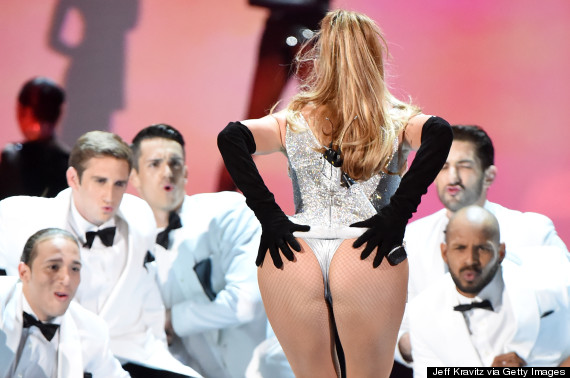
Overall, the daunting reality is that what's most visible in pop culture -- on our magazine covers, television shows and runways -- often becomes the desired look. The way Vogue participates in this (i.e. that they feel they should be applauded for discovering that other bodies exist in 2014) is hugely problematic. Their role in culture contributes to and reflects a very real (and totally myopic) world view. All of the white people who think twerking is a 2013 invention also probably see the celebration of big booties as a newfound thing, because it is suddenly being embraced and recognized by white culture. That sucks, and we can (and should) make fun of it, but maybe there's a glimmer of hope in all the offensive ridiculousness at play here.
We don't need Vogue to believe in big booties for them to exist. We don't need Vogue's acknowledgement of any body part or type. That's the real power of J.Lo's role as a "trailblazing butt girl," as Garcia called her. She represents not just the glory of her backside, but the confident presentation of a form that falls far outside the size zero standard. Reducing that to the idea that a specific body part is something that's really hot right now just creates one more box for women to be placed in and ignores the value of all other bodies. That's precisely the kind of thinking we need to break from in order to truly be free of the unrealistic images we've been bombarded with since the premiere issue of Vogue. Body diversity is important whether the aesthetic ideals of the fashion world choose to acknowledge diverse bodies or not. Anyone who doesn't understand that is welcome to kiss our big, small and medium-sized butts.
Everything Else You Need To Know:
Follow Lauren Duca on Twitter: @laurenduca
Well, it happened: Vogue discovered big booties. In a post earlier this week, they declared that we are "officially in the era of the big booty" ... With "J.Lo to thank (or blame)." Absurd, yes, but when you get done face palming yourself, there's something really icky there. The post skips around the obvious racial overlay with the dexterity of a cricket playing hopscotch. And if refusing to directly acknowledge women of color wasn't offensive enough, the idea of a body type trend piece is as troubling as the ready image of several tiny, white models debating the merits of large behinds. If moving past the thin ideal means fetishizing body types to the point that they are "en vogue," we've missed a step on the path to body positivity. Having and embracing big butts is not "new" just because you've never seen them on a runway.
There's a lot to unpack here, so let's start with the fact of discussing the "big booty" without referencing women of color. To do so "perpetuates the idea that curves are new, trendy, covetable accessories, thereby dismissing women of color whose curves existed long before it was fashionable to have them, and whose bodies have been critiqued throughout history" (as Carimah Townes wrote for Think Progress in response to Vanity Fair's Jen Selter story). Author of the Vogue piece, Patricia Garcia, even goes so far as to include Miley Cyrus in the movement, saying she "proved you didn't need to have a large butt to become a part of the conversation." It's bad enough to ignore African American and Latino women who have proudly been part of this butt "conversation" since the dawn of humanity. Giving credit to an individual who actively accessorizes herself with these women is just irresponsible.
Probably the most egregious aspect of the whole thing is that Vogue alleges a big butt is something women have been required to try to get rid of. "For years it was exactly the opposite," Garcia writes. "A large butt was not something one aspired to, rather something one tried to tame in countless exercise classes." That statement buys so whole-heartedly into the idea of a societally dictated body type it should make you want to drown in an over-priced kale smoothie. In spite of Vogue's lack of approval, there are plenty of women who have not spent all previous decades aspiring to whittle themselves down via Soul Cycle.
Overall, the daunting reality is that what's most visible in pop culture -- on our magazine covers, television shows and runways -- often becomes the desired look. The way Vogue participates in this (i.e. that they feel they should be applauded for discovering that other bodies exist in 2014) is hugely problematic. Their role in culture contributes to and reflects a very real (and totally myopic) world view. All of the white people who think twerking is a 2013 invention also probably see the celebration of big booties as a newfound thing, because it is suddenly being embraced and recognized by white culture. That sucks, and we can (and should) make fun of it, but maybe there's a glimmer of hope in all the offensive ridiculousness at play here.
We don't need Vogue to believe in big booties for them to exist. We don't need Vogue's acknowledgement of any body part or type. That's the real power of J.Lo's role as a "trailblazing butt girl," as Garcia called her. She represents not just the glory of her backside, but the confident presentation of a form that falls far outside the size zero standard. Reducing that to the idea that a specific body part is something that's really hot right now just creates one more box for women to be placed in and ignores the value of all other bodies. That's precisely the kind of thinking we need to break from in order to truly be free of the unrealistic images we've been bombarded with since the premiere issue of Vogue. Body diversity is important whether the aesthetic ideals of the fashion world choose to acknowledge diverse bodies or not. Anyone who doesn't understand that is welcome to kiss our big, small and medium-sized butts.
Everything Else You Need To Know:
- From over on the sports side of the pop culture world, we have the disgusting Ray Rice incident and unacceptable way the NFL has handled it. Flavorwire has a helpful intro post on the toxic culture of the league that might help you start to process that whole mess.
- Taylor Swift and Katy Perry are in a feud maybe! Read Gawker's partly fan-fiction timeline of why they hate each other so you don't loose too much sleep over their possible passive aggression.
- In case you have nothing to do this weekend, the entirety of "Gilmore Girls" is now on Netflix. Prepare for high-cal nostalgia with HuffPost TV's round up of the 18 most important episodes.
- U2 tried to pull a Beyonce, only to discover that only Beyonce can pull a Beyonce. Head over to Vulture for Lindsey Weber on how they botched the whole thing.
- Also, an ancient swamp pig has been named after Mick Jagger.


Follow Lauren Duca on Twitter: @laurenduca
You received this email from The Huffington Post.
If you'd like to update your account settings please go here.
If you'd like to unsubscribe from The Huffington Post please click here.
(C) 2014 The Huffington Post PO Box 4668 #22504 New York, NY 10163-4668


Sem comentários:
Enviar um comentário